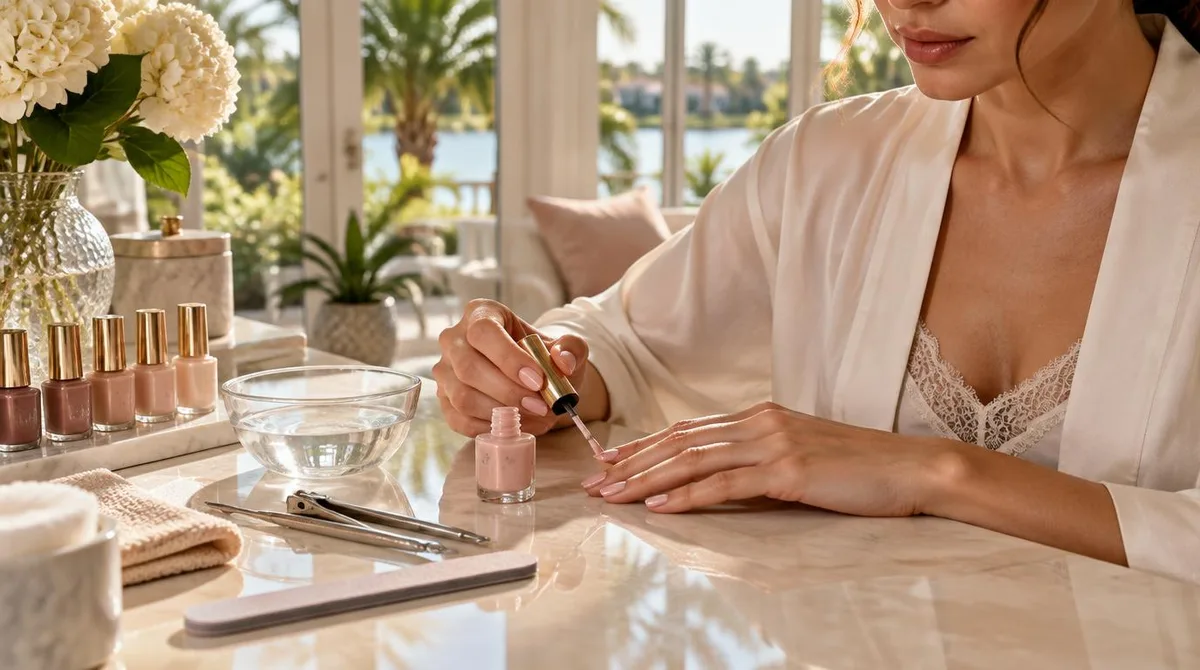
A good at-home manicure comes down to three things: clean prep, thin coats, and patience between layers. Skip any one of them and the polish lifts early, no matter what you paid for it. Do all three and a regular polish manicure can last close to a week, which is roughly what a basic salon version promises anyway.
The money case is simple. A basic manicure with regular polish runs $20 at one Port St. Lucie spa's published menu, and a gel manicure there runs $40. If you get your nails done twice a month, that is $480 to $960 a year before tips and add-ons. A starter kit of tools and polish costs less than a single gel appointment, and it lasts through many manicures.
This guide walks through the routine that matters, what each step actually does, and where the salon still earns its fee. It also covers the add-ons that are easy to skip. For more value checks like this one, our beauty section keeps a running list. We covered a connected angle in What "dermatologist tested" on a beauty label actually promises.
What are you actually paying for at a salon?
Most of the salon price is labor and time, not mystery products. The published menu at Prestige Nail Spa in Port Saint Lucie lists a basic manicure with regular polish at $20 for 30 minutes, a gel polish manicure at $40 for an hour, and a structured gel manicure at $50. Add-ons are priced separately: $10 for French polish, $10 for nail art, $20 for a deluxe manicure upgrade. Those are Florida prices as listed on the spa's booking page, and local menus elsewhere land in similar ranges.
What you buy is a trained hand doing prep, shaping, and application quickly and evenly. That skill is real, and it is why gel and acrylic work survives weeks instead of days. The products themselves are not exotic. The same polish brands, base coats, and top coats sold to salons are sold to you.
One more thing the fee covers: removal. The same menu charges $10 to remove gel polish with no new service. At home, removal is free, which changes the math if you like changing colors often.
Which prep steps actually matter?
Prep is the whole game. Polish fails when it cannot grip, and it cannot grip oil, lotion, or old residue. The routine that salons follow, and that you can copy, looks like this:
- Remove old polish completely, including the base coat layers that a quick swipe misses.
- Soak or soften the cuticle, then push it back gently with a wooden stick. Do not cut it. Cuticle protects the nail from infection.
- Shape with a file in one direction. Sawing back and forth heats the nail and splits the edge.
- Wipe the nail plate with a lint-free pad and alcohol or a dedicated cleanser. This lifts the last oils and helps the base coat bond.
That last step is the one home manicures skip most, and it is the one that decides whether your polish chips on day two or day seven. It costs almost nothing. A bottle of isopropyl alcohol and a bag of lint-free pads run a few dollars and cover months of manicures.
How do you make polish last longer at home?
Thin coats beat thick ones every time. A thick coat dries on the outside and stays soft underneath, so it dents and peels. Two thin color coats, with a minute or two between them, cure harder than one heavy coat.
Cap the free edge. When you paint the tip of the nail along with the top, you seal the edge where chips start. Top coat the tip too. This is the single most copied salon habit, and it takes two seconds per nail.
Reapply top coat every two or three days. A thin fresh layer re-seals the surface and restores shine. Keep the bottle in a cool, dark place; a thickened, gloppy top coat applies unevenly and defeats itself.
If regular polish never lasts more than a few days for you, gel-style systems at home are the honest alternative. They need an LED lamp and more careful removal, and the removal step is where home gel goes wrong. Peeling gel off rips layers off the nail plate. Soaking it off in acetone, the way a salon does, does not. If you are not willing to soak, stick to regular polish.
What this means for your budget
Our analysis: the at-home routine wins on frequency, not on replacing the salon entirely. Here is the split that makes sense.
- Do at home: regular polish manicures, polish changes, shaping, and cuticle maintenance between appointments. Each one costs you minutes, not dollars.
- Worth the salon fee: structured gel and acrylic work, dramatic shaping and length, and detailed nail art. Those need trained hands and professional products, and the published add-on prices show why. Nail art runs $10 for 15 minutes at the spa above, and a steady hand charging that little has practice you cannot shortcut.
- Skip entirely: paying for a polish change you could do in twenty minutes, and add-ons you cannot name a reason for. A deluxe upgrade is a nice treat, not a durability feature.
If you like running the numbers on beauty habits, we did the same exercise for hair color in salon vs box dye: what a year of each really costs. The pattern repeats: the cheap professional step is prep, and the expensive one is technique.
What the sources do not settle
The evidence here covers what salons charge and what their menus include. It does not measure how long any specific home routine lasts on any specific nail type, and no supplied source tested home kits against salon results. Nails differ. Some people get a week from regular polish; some get three days on the same routine. Treat any durability promise, from a salon or a kit box, as a claim until your own nails prove it.
Prices also move. The figures above come from one spa's published booking menu and one directory listing, and salon menus change without notice. Check your own local menu before you budget.
Is at-home nail care worth it?
For maintenance and color changes, yes, clearly. The tools cost less than one appointment and the routine takes practice, not talent. For gel, acrylic, and art, the salon earns its fee, and the published menus show exactly what that fee buys: time, technique, and removal you do not have to think about. Split the work that way and you get durability where it counts and savings where it is easy.