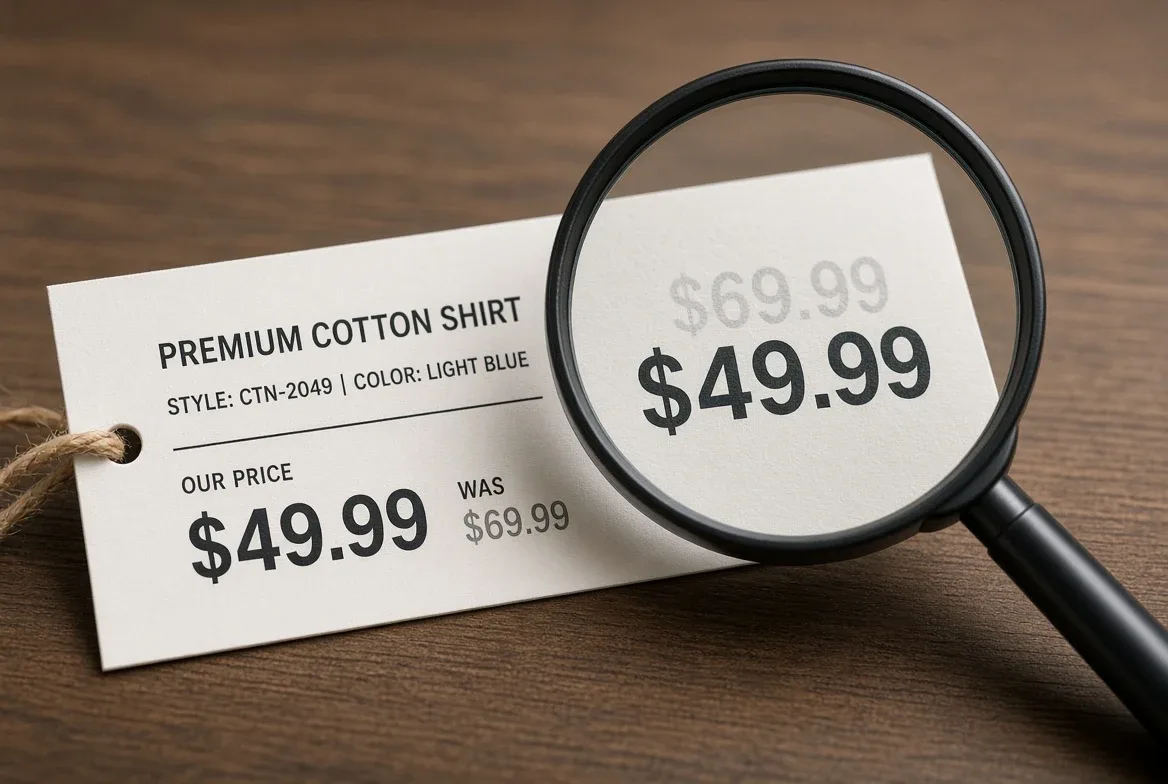
A legitimate "was" price is one a store actually, regularly charged before the markdown — not a number picked to make a discount look bigger. That's the standard set by federal rules on former-price advertising, and it's checkable in a few minutes with free price-history tools, before you decide whether a sale is worth acting on.
What actually makes a "was" price legitimate?
Under the Federal Trade Commission's guides on former price comparisons, a retailer can only advertise a former price if it was the "actual, bona fide price at which the article was offered to the public on a regular basis for a reasonably substantial period of time," and if it reflects the store's recent, regular business rather than "some remote period in the past." The item has to have been openly and actively offered at that price, not quietly listed and never sold. The rule also requires good faith: a former price set specifically to manufacture a bigger-looking discount, rather than one the store genuinely charged, is treated as deceptive under the same guidance.
The reduction has to be real, too. The FTC's language flags a comparison as false when the cut is "merely nominal" — the classic example given is marking something down from $10 to $9.99 and calling it a sale. A 40% markdown off a price the store charged for one afternoon fails the same test a 2% markdown does, just less obviously.
How often are advertised sale prices actual discounts?
Consumers' Checkbook, a nonprofit consumer-research organization, tracked prices weekly for 24 weeks starting in February 2025 across 25 national retail chains and more than 25 items per store, then compared what it found to the same kind of tracking it ran in 2015, 2018, and 2022. Its report found that 21 of the 25 chains advertised items as "on sale" more than half the time the researchers checked, and that across 19 of the chains, items carried a sale tag on roughly three out of every four visits — up from just six chains showing that pattern in 2018. In the same tracking period, the group found only a handful of retailers, including Apple, Costco, and Dell, consistently offered prices that moved the way a real discount should: down for a limited stretch, then back up. One additional chain landed in between, with about half of its tracked items discounted at least half the time. None of this means a given markdown you're looking at right now is fake — it means the base rate of "sale" tags being meaningful, across the retail sector broadly, is lower than the tags themselves suggest, which is exactly why checking the specific item in front of you is worth the two minutes it takes.
How do you check a price's actual history yourself?
You don't need a subscription or a spreadsheet. A short routine, repeated for anything you're about to buy on the strength of a "was" price, catches most of the fakes:
- Pull up a price-history tool before you check out. Browser extensions built on Amazon's price archive, such as Keepa and the Camelizer (built on CamelCamelCamel's data), chart an item's price over months, so you can see whether today's number is actually a low point or just back at the usual level.
- Check Google's built-in price insight, when it's available. On many product listings, Google Shopping shows whether the current price is typically higher, lower, or about the same as recent history for that item.
- Compare across retailers, not just against the one "was" price. A browser tool like Capital One Shopping surfaces prices for the same or similar item at other stores, which tells you whether the "sale" price is actually competitive or just competitive against that one store's own inflated number.
- Note how long the current price has been up, if the tool shows it. A price that's been flat for months and is now called a "limited-time" markdown is the pattern the FTC's rule is written to catch.
What if the price-tracking data doesn't cover what you're buying?
Price-history tools built on Amazon's catalog are strongest for electronics, home goods, and other items sold there at scale; they don't have the same depth of history for a specific coat at a department store or a limited-run beauty set. When there's no clean price chart for what you're buying, the fallback is simpler: check the retailer's own site history if it's browsable, compare the "was" price against what competitors are charging right now, and read the store's price-adjustment or price-match policy before you buy, so a post-purchase drop isn't money left on the table. None of the sources behind this piece measured how consistently individual clothing or beauty retailers apply former-price rules specifically, so treat any single "was" price on those categories as unverified until you've checked it yourself.
What should you do if the numbers don't line up?
If a price-history check shows the "was" price barely existed, or existed only briefly right before the sale started, that's the pattern regulators treat as the problem case — not proof of anything about a specific retailer's intent, but a reason to shop the item on its current price alone rather than the advertised discount. Skip retailers' price-match policies at your own cost: many will refund the difference if a price drops within a set window after you buy, which is worth checking before, not after, you place an order.
For a related value perspective, read How to tell if that “was” price is actually real.