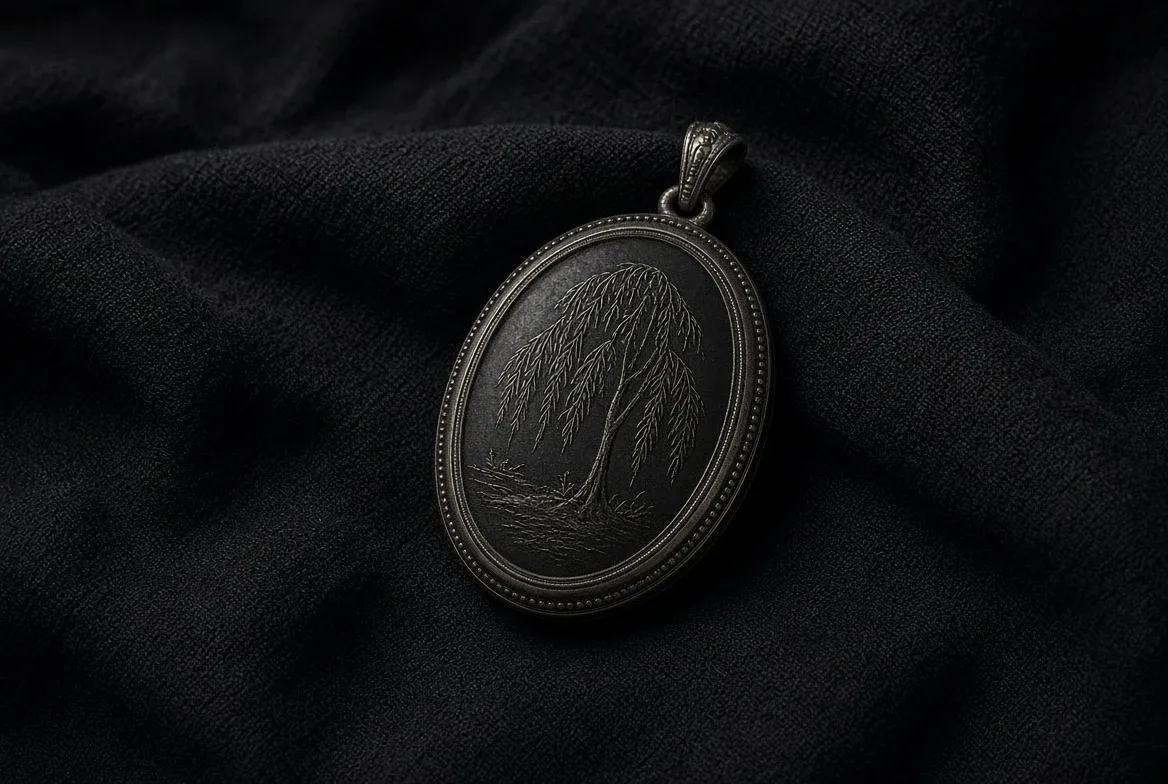
Goth fashion did not start on a runway or in a nightclub — the record, as laid out by the first museum exhibition ever devoted to the style, traces it to eighteenth-century gothic literature and nineteenth-century mourning ritual, long before it became a subculture uniform in the early 1980s. That's the argument The Museum at FIT made explicit in "Gothic: Dark Glamour," curated by Dr. Valerie Steele and running September 5, 2008 to February 21, 2009 — the qualification worth holding onto is that the look has always borrowed from more than one century at once.
The show mattered because no institution had treated the aesthetic as design history before. It drew a line from terror novels through Victorian grief customs to the designers currently reworking both, and it named the strands of the subculture itself rather than flattening them into one look.
For readers who want the collections side of this — cut, hardware, the compromises of small-run production — that coverage lives here, alongside the labels doing the work today.
Where does the word "gothic" in fashion actually come from?
Before it named a look, gothic named a literary genre. Steele's curatorial statement for the FIT show put it plainly: "Although popularly identified with black-clad teenagers and rock musicians, the gothic has also been an important theme in contemporary fashion." The exhibition traced that theme from eighteenth-century gothic terror literature, through vampire narratives and horror cinema, into the fashion of the present — a lineage of image and mood, not a single invented moment.
The throughline Steele named was tonal rather than technical: "the imagery of death and decay, the power of horror, and the erotic macabre are perversely attractive to many designers," she said of why the register recurs on runways that have nothing to do with any music scene. That's the case for treating gothic as an aesthetic current with its own long history, rather than a costume borrowed wholesale from one decade.
What did Victorian mourning culture actually contribute to the look?
Death ritual is where the darkness gets its material vocabulary — the black crepe, the veiling, the memento mori worn on the body rather than just referenced by it. The Smithsonian's National Museum of American History holds an early-nineteenth-century example that shows the mechanics directly: a mourning pendant dated 1800–1820, its ivory plaque painted with a woman and child at a tomb inscribed "Rest in Peace," a weeping willow arched over an urn, framed in gold. The museum's own catalog record notes the willow as a recurring mourning symbol through the nineteenth century, and describes the piece as both a private memento and a public marker of loss worn under strict social rules about how long, and how visibly, a woman grieved.
That's the same material logic — memento, symbol, worn grief — that the FIT exhibition placed as one of its core historical rooms, alongside gothic literature and vampire imagery, as the show's grounding for why gothic fashion reads as mourning wear that never fully left the body.
When did gothic aesthetics become a subculture's actual dress code?
The FIT exhibition's own structure marks the split: it grouped the contemporary subcultural end of the look into named, dated strands rather than one undifferentiated "goth" — "old-school goth" placed at 1979–83, alongside industrial, steampunk, and cyber-goth as later, distinct branches. That dating situates the subculture's emergence at the turn of the 1980s, decades after the literary and mourning material the exhibition traced it back to — the look didn't originate with the subculture; the subculture picked it up.
A parallel account comes from outside the museum world: a 2016 exhibition catalog held by the Smithsonian Libraries and Archives, "Gothic to Goth: Romantic Era Fashion & Its Legacy" by costume historian Lynne Z. Bassett, catalogued under the subject headings clothing and dress, goth culture, and Romanticism's influence — an independent scholarly confirmation that the line from Romantic-era dress to the goth subculture is treated as continuous rather than coincidental by more than one institution.
How did an academic museum end up treating goth as serious fashion, not costume?
"Gothic: Dark Glamour" staged that argument physically. FIT built the Special Exhibitions Gallery as a labyrinth of themed rooms — Night, Ruined Castle, Laboratory, Haunted Palace — and hung more than 75 ensembles across them, deliberately mixing high fashion against subcultural and independent labels rather than segregating one from the other.
The high-fashion side of the checklist included Alexander McQueen, Ann Demeulemeester, Comme des Garçons, John Galliano for Christian Dior, Jean Paul Gaultier, Rick Owens, Rodarte, Yohji Yamamoto, and Thierry Mugler, among others — designers with no shared scene affiliation, unified only by the recurring pull toward the same imagery Steele described. Set against them were subcultural and independent labels including Kambriel and Plastik Wrap, plus elegant gothic lolita design from h.Naoto Blood, placed in the same rooms rather than a separate wing.
The show was accompanied by a companion book from Steele and co-author Jennifer Park, published by Yale University Press with proceeds supporting the museum, and by a public program — a "Subculture and Style" fashion symposium — that put the runway and the street scene in the same conversation rather than treating one as the legitimate half of the story.
What actually separates the runway trend from the subculture's own dress?
The exhibition's taxonomy is the clearest answer available: within the subcultural wing alone, it distinguished old-school goth, Victorian goth, industrial, steampunk, cyber-goth, and elegant gothic lolita as separate, dated developments rather than interchangeable synonyms for "goth." A runway collection can borrow the imagery — the memento mori, the corsetry, the funerary black — for one season and move on. A subculture's dress code is worn as an ongoing identity, developed in dialogue with music scenes and maintained over decades, which is precisely why the museum needed six subcategories where a trend report would need one.
The qualification that matters for any reader tracing the look back further: none of this makes the subculture a costume version of eighteenth-century literature or Victorian grief. The FIT exhibition and Bassett's catalog both treat the relationship as legacy and dialogue — later wearers reworking inherited imagery on their own terms — not a fashion house's invention retroactively adopted by fans.
Why does the mourning-pendant object matter more than a runway reference?
An object like the Smithsonian's mourning pendant is useful precisely because it predates any fashion industry's involvement in the aesthetic by well over a century. Nobody designed the weeping-willow motif or the ivory tomb scene for a collection; the museum's record frames it as a private ritual object, made and worn under social rules about visible grief that had nothing to do with style for its own sake. That's the distinction the FIT exhibition kept returning to across its four themed rooms — Night, Ruined Castle, Laboratory, Haunted Palace — each pairing a literary or ritual source against the fashion that later drew on it, rather than presenting the fashion as self-originating.
Reading the two Smithsonian-held records against the FIT show's own structure gives a rare thing for a subculture's fashion history: three independent institutions — a fashion museum, a costume historian's scholarly catalog, and a national history museum's own object archive — converging on the same account without any of them citing the others as their source. The gothic look, on that record, is neither a fashion invention retrofitted with borrowed gravity nor a subculture spontaneously generating its own imagery from nothing. It is one of the rare aesthetics where the paper trail — literature, mourning ritual, then subculture, then runway — actually holds up when three unrelated archives are checked against each other.
For more context, read How Four Councils Set the Spring 2027 Fashion Week Calendar.
For more context, read swimwear.