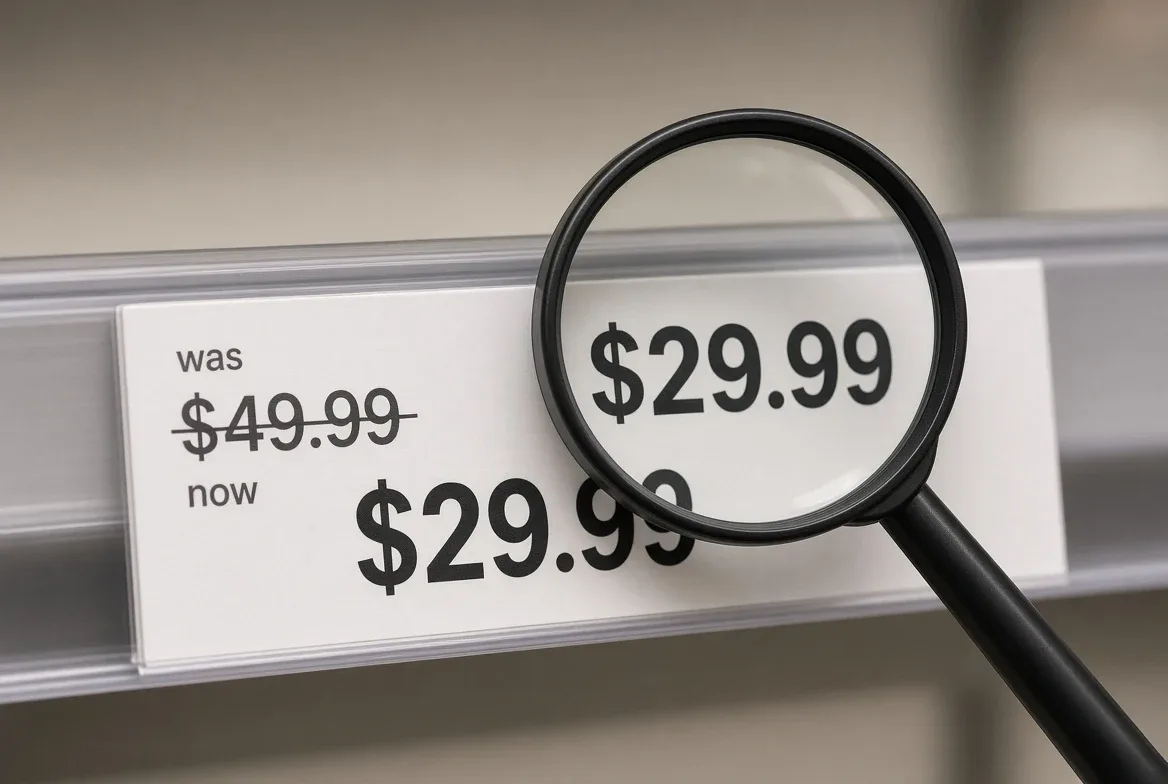
A retailer's "was" price is only a legitimate discount baseline if it was the actual, regularly charged price for a reasonably substantial stretch of time — not a number invented to make a markdown look bigger. That standard comes straight from the Federal Trade Commission's own pricing rule, and it's the reason some sale racks feel honest and others feel like theater.
The rule itself isn't new, dating back decades, long before online price trackers and daily flash sales existed. What's changed is how much a shopper can check in a couple of minutes: retailer price-history pages, browser extensions, and cached listings now make it possible to see whether a was price actually held for a while, instead of taking the sticker on faith.
What makes a "was" price legal in the first place?
The rule sits in the FTC's Guides Against Deceptive Pricing, in the section on former price comparisons. It says a former price qualifies as a fair comparison point only "if the former price is the actual, bona fide price at which the article was offered to the public on a regular basis for a reasonably substantial period of time," according to the regulation's text.
That's a two-part test: the price has to have been real — sold at, not just listed at — and it has to have lasted a while, not a single afternoon before the markdown hit. The same section warns against fictitious or inflated prices created solely to justify a later "discount," and it singles out nominal reductions, like cutting $10 to $9.99, as the kind of gimmick that shouldn't be marketed as savings.
Why do "up to 70% off" racks feel like a trick?
Often because the top figure applies to a handful of items, not the rack. A related section of the same rule covers list prices and manufacturer suggestions, and it requires that a comparison price reflect what a substantial share of actual sales happen at in a given market — not just whatever a manufacturer proposes. The rule separately tells advertisers not to call a retail price a "wholesale" or "factory" price when it isn't, and not to imply a special offer is ending when it isn't really limited at all.
None of that means an "up to" sale is automatically deceptive. It means the honesty of the claim depends on how many items actually hit that top number — a detail the sign in the window is never going to volunteer.
Is anyone actually checking these claims?
Enforcement is real, if uneven, and it's active right now. In August 2026 the FTC published a consumer alert warning shoppers specifically about sale claims on social media, using the example of an ad implying "that designer bag you've been dreaming of is 50% off for a limited time only." The agency's point wasn't that every such ad is fake — it's that platforms "don't always thoroughly vet the ads you see or the advertisers behind them," so the burden of checking shifts to the shopper.
The commission has also been pushing on pricing transparency more broadly this year. In March 2026 it warned 97 auto dealership groups that advertised prices must reflect "the total price — including all mandatory fees — that consumers will be required to pay," per a separate FTC press release. That action covered vehicle pricing, not clothing or beauty sales, but it's a useful signal: the same agency that wrote the former-price rule is currently spending enforcement attention on price honesty across categories, not filing it away as settled law.
So how do you tell if a sale is real?
None of this requires a law degree. A few habits do most of the work.
- Look for a price history, not just a sticker. If a retailer or a price-tracking tool shows the "was" price only appeared right before the markdown, that's a reason to look closer — though it isn't proof of a rule violation on its own.
- Ask what share of the rack hits the top discount. "Up to 70% off" is a range, not a guarantee; the item in your hand may be discounted far less than the headline number.
- Compare to a typical price, not a peak one. A legitimate former price is what the store regularly charged, not the highest price it ever touched during a holiday rush.
- Check the date on any price claim you're relying on. Sale structures and clearance pricing shift fast; a screenshot from last month doesn't confirm today's price.
- When the math matters, ask the retailer directly. Return windows and price-adjustment policies are public and enforceable even when a "was" price is genuinely fuzzy.
- Treat one low price as a data point, not proof. A single markdown, even a genuine one, doesn't by itself tell you whether a category has entered a real sale season or is running a short, isolated promotion.
Worth saying plainly: this rule tells you how a former price is supposed to work, not whether any specific sale you're looking at today breaks it. Whether a particular retailer's pricing practice is unlawful is a legal question for a court or the FTC to decide, not something to conclude from a markdown sticker. Regulatory guidance and enforcement priorities can also shift, so treat the dates on this piece — and on any sale claim — as part of the evidence, not a footnote.
For a related value perspective, read How to tell if that “was” price is actually real.